- Home
- China
- World
- Europe
- Politics
- Business
- Opinions
- Tech & Sci
- Culture
- Sports
- Travel
- Nature
- Picture
- Video
- Live
- TV
- Specials


Share







Copied
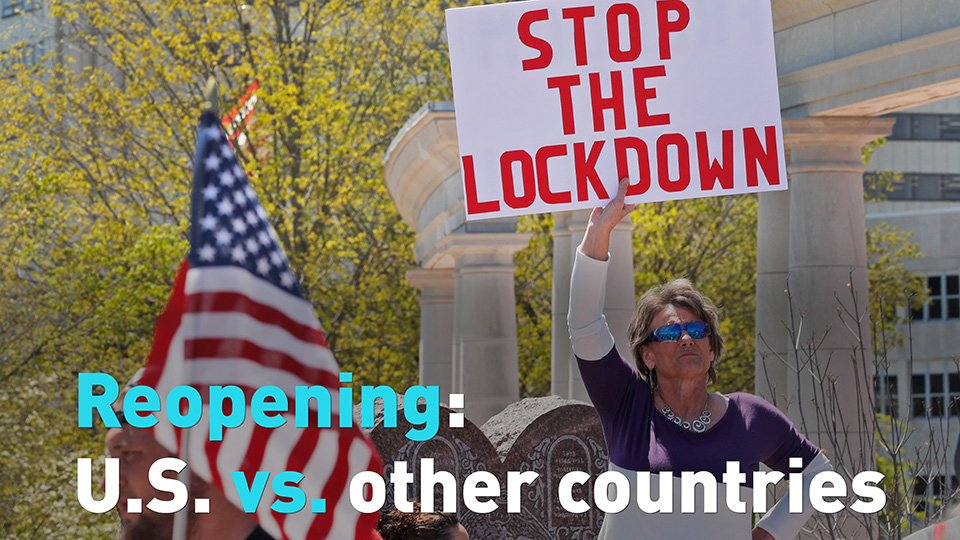
America is having heated debate on how soon the country's economy can reopen.
According to an Associated Press-NORC survey, majority of Americans support current stay-at-home orders.
Over 26 million Americans have filed unemployment claims since the COVID-19 pandemic hit.
Protests are growing across the country, urging states to lift restrictions.
According to Johns Hopkins data, the U.S. has highest total death toll and confirmed cases of coronavirus in the world, with more than 53,000 deaths and cases approaching one million.
State governors are facing pressure to strike a balance between saving lives and saving livelihoods.
Georgia has become the first state in the U.S. to reopen non-essential businesses including gyms, spas, beauty salons, barber shops and tattoo parlors after issuing the stay-at-home orders three weeks ago.
European countries are moving cautiously to ease lockdown restrictions as the rate of new infections and deaths there slow.
In Italy, after six weeks on lockdown, bookshops, stationers and other small businesses were allowed to reopen although nationwide social distancing measures remain in place. Businesses in the manufacturing, auto, fashion and design sectors, including shopping malls, will begin reopening next month.
In Germany, stores up to 800 square meters in size, along with car dealers, bicycle shops and bookstores were allowed to reopen this week under an agreement between the leaders of Germany's 16 states. Chancellor Merkel urges to reopen the country gradually in "smart and careful" ways.
Life in China has been slowly returning to normal after Wuhan ended its 76-day strict lockdown in early April.
For the first quarter of 2020, China's GDP dropped 6.8 percent compared to the same period last year. During a recent visit to northwest China's Shaanxi Province, Chinese President Xi Jinping said, "with continued epidemic prevention and control as a precondition, we must now actively push forward the resumption of work and production."