- Home
- China
- World
- Europe
- Politics
- Business
- Opinions
- Tech & Sci
- Culture
- Sports
- Travel
- Nature
- Picture
- Video
- Live
- TV
- Specials


Share







Copied
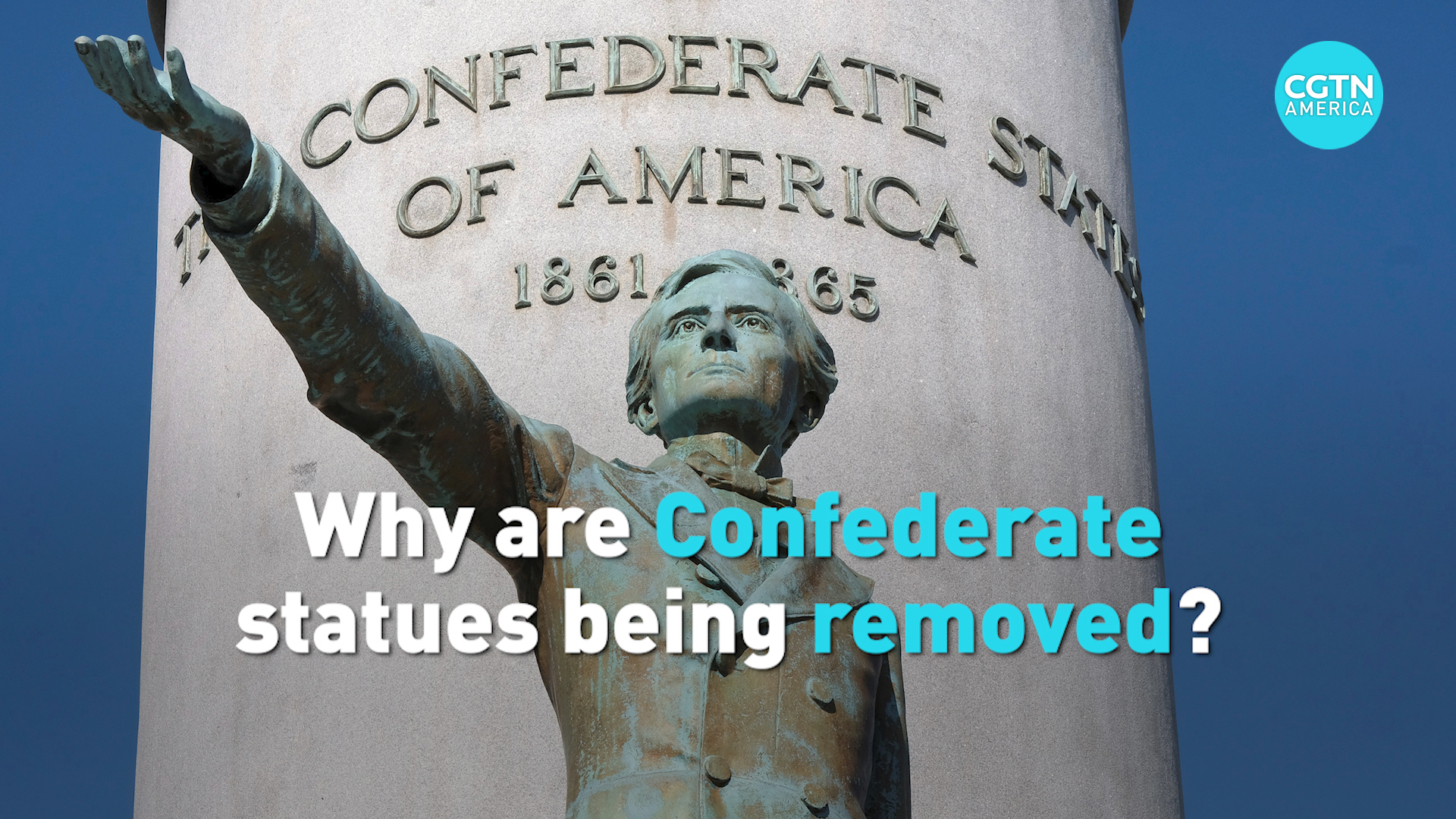
As protests against systematic racism and injustice over George Floyd's death grow, many are demanding the removal of Confederate statues around the U.S.
The debate on confederate monuments began during the rise of Black Lives Matter movements and the “Unite the Right” rally in Charlottesville, VA in 2017, where white nationalists gathered to protect the statue of Confederate General Robert E. Lee, that the city planned to remove. The rally ended with one person dead, multiple injured.
Monuments and statues of Confederate leaders or Christopher Columbus, have been controversial over the years, with calls from many to remove them.
Donald Collins, Adjunct Professorial Lecturer of History at American University says this move was a long time coming. "I think that when you think about the totality of systemic racism and the legacy of those Confederate statues and how one is related to the other, they pretty much represent the symbol of the systemic racism that existed in this country before the country was actually founded in 1776."
Mr. Collins also highlights that most African-Americans felt many progressives don't want the statues removed because Confederate statues and other memorials symbolize racism in the rock.
Confederacy or the Confederate States of America, was a union of 11 Southern states during 1861-65. Headed by Jefferson Davis, their way of life was predominantly white supremacy and the institution of slavery.
But after the election of Abraham Lincoln as the U.S. President, the belief of Confederates was threatened.
Abraham Lincoln opposed slavery. The confederates then declared a rebellion against the U.S. But by 1865, the confederacy collapsed and statues erected to remember the "lost cause".
"A lot of folks in the South after Confederacy lost the Civil War in 1865 still wanted the honor, what they call the lost cause. In fact, that while they lost, they wanted to honor their heroism. But they also wanted to do the sort of the symbolize the fact that this is our country," Mr. Collins said. "This is a white man's country. And if we put these statues up, that actually reinforces this fact. While there are also imposing Jim Crow segregation throughout the South, this is the same period. And so these these statues, these monuments are symbols of this lost cause."
Many cities and states have officially signed to remove the confederate statues - Albany, Birmingham, Dallas, Virginia, Indianapolis, Jacksonville, Louisville, Montgomery, Philadelphia, Sacramento, etc.
In many places, statues of Confederate leaders were vandalized. In Boston, statue of Christopher Columbus was beheaded. In Richmond, VA, the statue depicting Confederate leader Jefferson Davis, Gen. Williams Carter Wickham and Christopher Columbus were toppled.
"There are plenty of museums around. We we're not saying get rid of museums that talk about the legacy of slavery and the Civil War, but we're not honoring into it. That's the difference between having a museum tour in places like Alabama, or Jackson, Mississippi, and other parts of the country where the issue is with this is what slavery represented," Mr. Collins said. "This is what lynching representatives of Jim Crow represent versus having a statue up where we're going to honor Robert E. Lee in Richmond or we're going to honor Stonewall Jackson somewhere else in Virginia, or work on the honor of Faneuil. Why do we need that? That's not part of remembering the history that's honoring these people. And there is a difference."