- Home
- China
- World
- Europe
- Politics
- Business
- Opinions
- Tech & Sci
- Culture
- Sports
- Travel
- Nature
- Picture
- Video
- Live
- TV
- Specials


Share







Copied
New cases of COVID-19 rose by nearly 69,000 across the United States on Friday, setting a record for the third consecutive day as Walt Disney Co. stuck to its plans to reopen its flagship theme park in hard-hit Florida. Daily deaths are also on the rise.
This week, Texas, Arizona, Alabama, Florida, Mississippi, South Dakota and Tennessee all set single-day death records. The surges in Georgia, Louisiana, Montana, Ohio, Utah and Wisconsin also helped to put the U.S. on a pace to set a new national record.

Health experts say it is still too early to predict a trend in the national data but that the rising pace of deaths across several states likely signals an end to the country's overall downward trend in COVID-19 deaths.
Florida recorded 11,433 new coronavirus cases on Friday, the state health department said, just short of the state's record high and more evidence that it was at the center of the U.S. pandemic. Experts attribute the surge in new cases to states in the South and West that were among the first to ease COVID-19 restrictions.
Infections are also rising in the U.S. military, with cases more than doubling in one month. Friday, the Pentagon reported a total of 16,637 positive cases across all branches of the military since the pandemic began. That's up from 7,408 cases reported as of June 10.
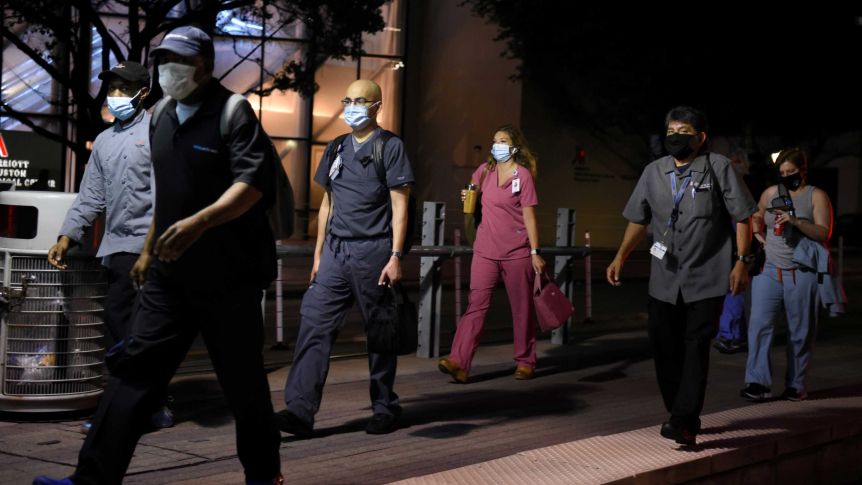
The U.S. recorded another record increase in daily COVID-19 cases on July 10. /AFP
School reopening under pressure
Groups representing the nation's doctors, teachers and top school officials on Friday pushed back against pressure from President Donald Trump to fully reopen U.S. schools despite a surge in coronavirus cases, saying science must guide the decisions.
Trump is demanding the CDC amend its guidelines, which include social distancing measures, calling them "tough & expensive." Dr. Robert Redfield, the head of the CDC, says no changes are planned, but the agency will issue "additional reference documents."
"Public health agencies must make recommendations based on evidence, not politics," the American Academy of Pediatrics (AAP), two national teachers' unions and a school superintendents' group said following days of threats by Trump to choke off federal education funds if schools do not open their doors for the upcoming academic year.
"We should leave it to health experts to tell us when the time is best to open up school buildings, and listen to educators and administrators to shape how we do it," the AAP, the American Federation of Teachers, the National Education Association and the School Superintendents Association said in a joint statement.
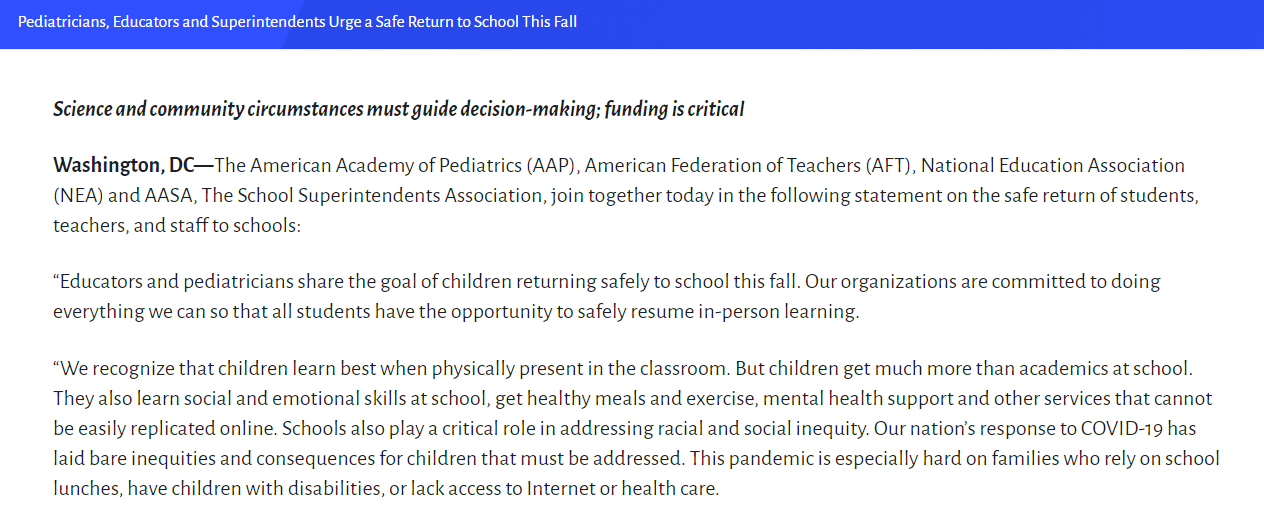
The American Academy of Pediatrics, American Federation of Teachers, National Education Association and the School Superintendents Association issued a joint statement on the safe return of students and staff to schools on July 10. /CGTN screenshot
Their call was echoed by two medical groups – the Infectious Diseases Society of America and the HIV Medicine Association.
Despite evidence children are less vulnerable, the fear of classroom contagion is shared by many parents, who suspect younger pupils will particularly struggle to socially distance or wear uncomfortable masks for hours.
Many American parents are also desperate for their kids to return, whether for financial reasons as they plan to go back to work, or out of fear that their children's education will be seriously damaged by months away from the classroom. This conflict has spilled into the political arena too, with President Donald Trump this week vowing to open schools "quickly, beautifully, in the fall."
Trump ramped up his threat on Friday, saying the Treasury Department would re-examine schools' tax-exempt status and their federal funding. Around 90% of U.S. schools funds come from state and local levels, but schools receive targeted dollars from the U.S. Department of Education. And this money often affects the students in the most vulnerable conditions.
Florida now the epicenter
Besides the chaos of school reopening, U.S. COVID-19 epicenter has transferred to the south and west of the country. Earlier this week, more than four dozen Florida hospitals reported their intensive care units were full, yet the state does not disclose the number of hospitalized COVID-19 patients.
This month, Florida has repeatedly reported more new daily coronavirus cases than any European country had at the height of their outbreaks. Its positive test rate, at 19 percent earlier this week, is one of the highest in the country.
Florida Governor Ron DeSantis angered some residents and medical experts by calling the spike a "blip."
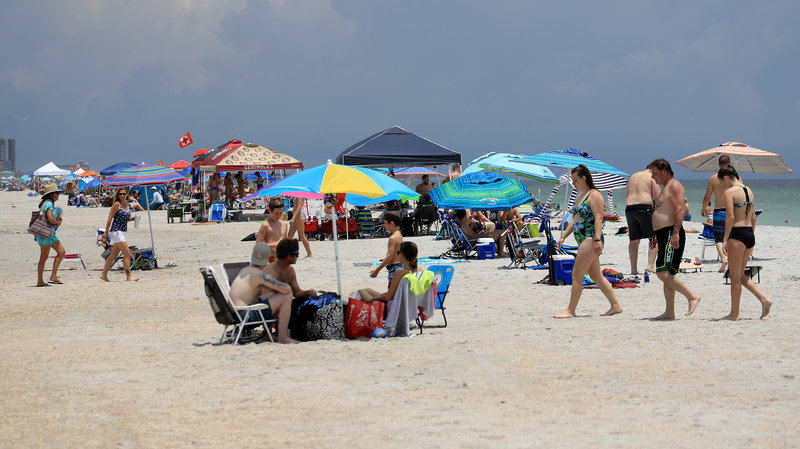
Florida has repeatedly reported more new daily coronavirus cases than any European country had at the height of their outbreaks. /AFP
On Friday, DeSantis said that the state would receive more than 17,000 vials of the antiviral drug remdesivir from the U.S. government, adding "that'll be something that will hopefully help to improve patient outcomes."
Walt Disney World became the latest flash point in a national debate over access to public spaces.
The Walt Disney Co. said the theme parks in Orlando would open on Saturday to a limited number of guests, requiring all visitors and employees to undergo temperature checks and wear face masks. Parades, firework displays and other crowd-drawing events remain canceled.
Disney's chief medical officer said this week that she believed the broad set of safeguards the company developed with health experts would allow guests to visit the park safely.
(With input from agencies)
Check out The China Report, our new weekly newsletter. Subscribe here!