- Home
- China
- World
- Europe
- Politics
- Business
- Opinions
- Tech & Sci
- Culture
- Sports
- Travel
- Nature
- Picture
- Video
- Live
- TV
- Specials


Share







Copied
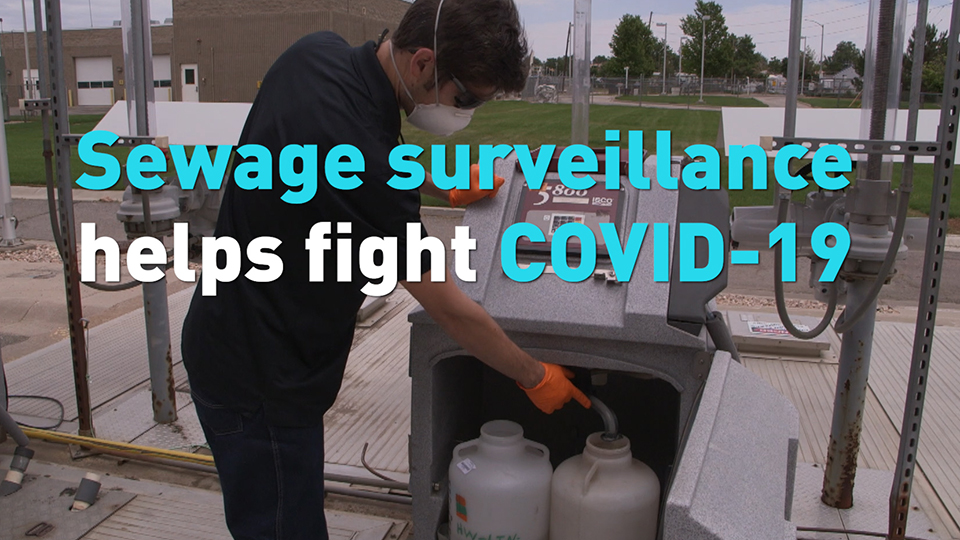
At South Platte Renew, a wastewater treatment plant in the Denver area, an employee collects a sample of sewage water. It's done here daily.
"We take it right at the front of the plant so that there's been no treatment process yet," said Pieter Van Ry, South Platte Renew's director. "They're automatic pumps that pull right from where the influent stream is and they pump the water out and stick it into a sample bottle that we then take to our lab and package up."
Samples are sent to Biobot Analytics, a wastewater-testing startup near Boston, which is busy examining sewage for presence of the coronavirus.
"I saw an article in Popular Mechanics and thought this would be an interesting possible study for us to participate in," Van Ry said.
400 such facilities in 42 states across the U.S. are now part of the effort. SARS-CoV-2 is shed in the stool of COVID-19 patients within three days of infection. By tallying genetic fragments of the virus, Biobot determines its concentration per liter of sewage and the density of infection in a certain community. It can quickly detect outbreaks. "What we hope is that this information can complement existing epidemiological data to better understand when to reopen cities as well as well as an early warning system for the reemergence of the virus," said Mariana Matus, Biobot C.E.O.
It turns out sewage can tell us a lot about public health. "That was the first time I'd come across that type of connection between wastewater and pathogens," Van Ry said.
In fact, fecal tracking has been used to look for polio. It can reveal the presence of environmental contaminants as well as drugs. Biobot's discovery of opioids in sewage allowed one North Carolina city to do interventions the company claims cut overdoses by 40 percent. It insists sample collectors are not at risk of catching the virus and because wastewater is a mix of information, individual privacy will not be compromised. Biobot C.E.O. Mariana Matus believes sewage could become a key disease-fighting tool. She hopes that this type of technology will be used at scale in every city, in every town, not only in the U.S. but in the world."
Early findings show the coronavirus may be much more prevalent in the population than clinical tests show. 10 percent of all Americans, including 300,000 Coloradans who rely on this plant, are being studied now. "I think we can always learn more from wastewater than is probably immediately understood," Van Ry said.
Sewage can be very revealing and, at a time when testing remains inconsistent in the U.S., helpful in measuring the scale of this pandemic.