- Home
- China
- World
- Europe
- Politics
- Business
- Opinions
- Tech & Sci
- Culture
- Sports
- Travel
- Nature
- Picture
- Video
- Live
- TV
- Specials


Share







Copied
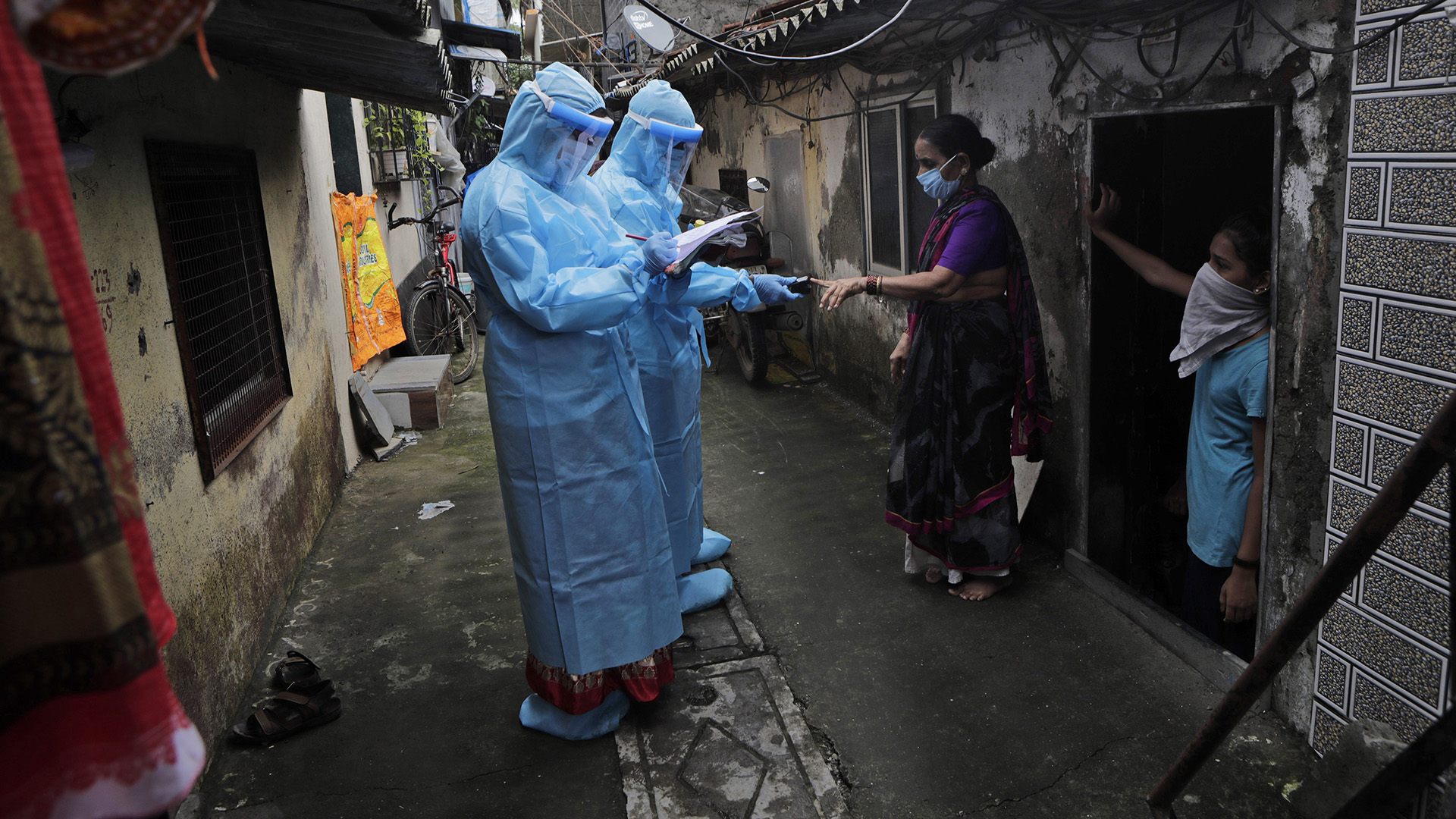
Health workers screen residents for COVID-19 symptoms at Deonar slum in Mumbai, India, Saturday, July 11, 2020. In just three weeks, India went from the world’s sixth worst-affected country by the coronavirus to the third, according to a tally by Johns Hopkins University. India's fragile health system was bolstered during a stringent monthslong lockdown but could still be overwhelmed by an exponential rise in infections. (AP Photo/Rajanish Kakade)
In less than a month, India's coronavirus cases grew so fast that it is now has the third-highest number of cases in the world and the numbers are still growing.
Only the United States and Brazil surpass India in cases.
As of Saturday afternoon, there were nearly 821,000 reported cases and 22,100 deaths, according to Johns Hopkins University.
In Mumbai, the nations largest city, there were a total of 90,461 cases reported as of Saturday, according to the Indian Express.
India's economy has reopened since June 8 and consumer activity is at pre-pandemic levels. Factory workers who fled cities when India imposed its lockdown March 24 have begun to return, enticed, in some cases, by employers offering free room and board, the Associated Press reported.
Hospital morgues in India have been beyond capacity as have cemeteries and crematoriums.
Funerals are also limited to a certain number of people making mourning very challenging.
Public health in India is managed at a state level, and some have managed better than others, according to the AP.
The southern state of Kerala, where India's first three virus cases were reported, has been held up as a model. It isolated patients early, traced and quarantined contacts and tested aggressively.
By contrast, Delhi, the state that includes the national capital, has been sharply criticized for failing to anticipate a surge of cases in recent weeks as lockdown measures eased.
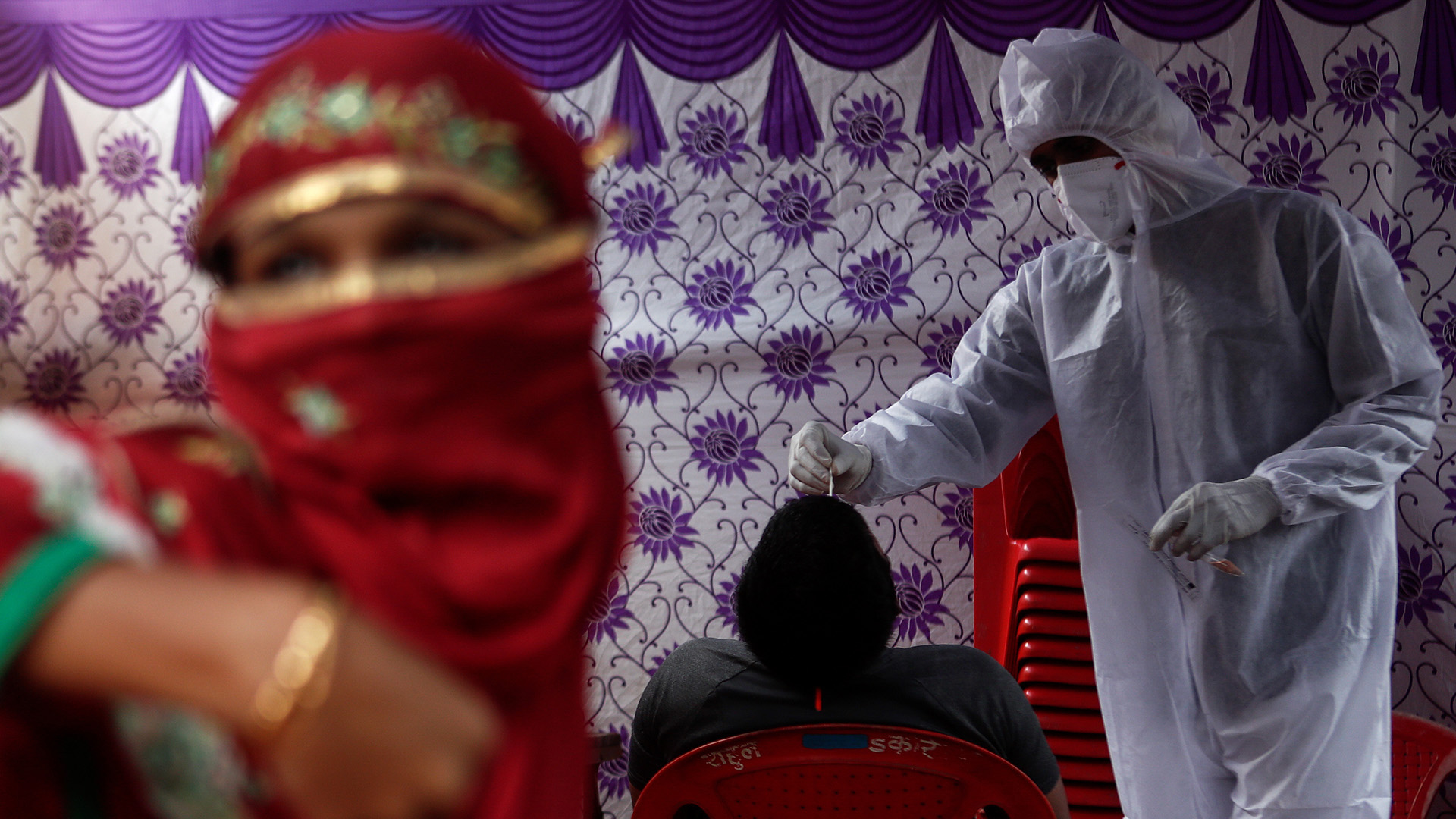
A woman waits to be tested as a health worker in personal protective equipment (PPE) collects a sample from a person using a swab to conduct tests for the coronavirus disease (COVID-19), in Mumbai, India July 11, 2020. REUTERS/Francis Mascarenhas
DRUG HOPES SPAWN LONG QUEUES
Last night, more than 500 people lined up outside a pharmaceutical company just outside of Mumbai, after they heard that they had 400 vials of the COVID-19 drug tocilzumab.
The drug, which also goes by the name atlizumab, is used alongside Remdesivir to treat moderate to critical coronavirus patients and it's been hard to find in the last few months, the Mumbai Mirror reported.
Each vial costs 40,000 rupees or $532.
There has been a shortage of tocilzumab in India, and prices on the black market have reached 75,000 rupee per vial or nearly $1,000, the Mumbai Mirror reported.
The Municipal Corporation of Greater Mumbai has said it will buy 20,000 vials of the drug and are currently negotiating with Swiss drugmaker Roche Pharma for 15,000-30,000 rupees ($200-$400) depending on the dosage, the Economic Times of India reported.
India's Health Ministry has recommended the drug for patients who need increasingly more oxygen or are on ventilators and are not improving with steroids, the Economic Times of India reported.
The drug was initially prescribed for patients with rheumatoid arthritis. But it began being used as a coronavirus treatment after doctors in China noticed it had positive effects on COVID-19 patients.
But a very similar drug, sarilumab, was recently the subject of a trial cancellation after French drugmaker Sanofi and U.S. drugmaker Regeneron found it didn't improve severe cases of COVID-19.
The head of the tocilizumab trial in India told the Economic Times that it's unclear if tocilizumab differs from sarilumab but said "excessive use of drugs such as tocilizumab is coming in the way of completing clinical trials."
On Saturday, India's Health Ministry said that investigational therapies such as tocilizumab should be used with caution due to the potential adverse side effects including liver and kidney injury.
The Indian Council of Medical Research and the All India Institute of Medical Sciences also warned states to only use remdesivir and tocilizumab strictly under set prescriptions saying "indiscriminate use or use in conditions for which they are not desirable may cause more harm than good".
The Health Ministry added that remdesivir and tocilizumab have not shown any benefits in terms of reduced mortality.
Check out The China Report, our new weekly newsletter. Subscribe here!