- Home
- China
- World
- Europe
- Politics
- Business
- Opinions
- Tech & Sci
- Culture
- Sports
- Travel
- Nature
- Picture
- Video
- Live
- TV
- Specials


Share







Copied
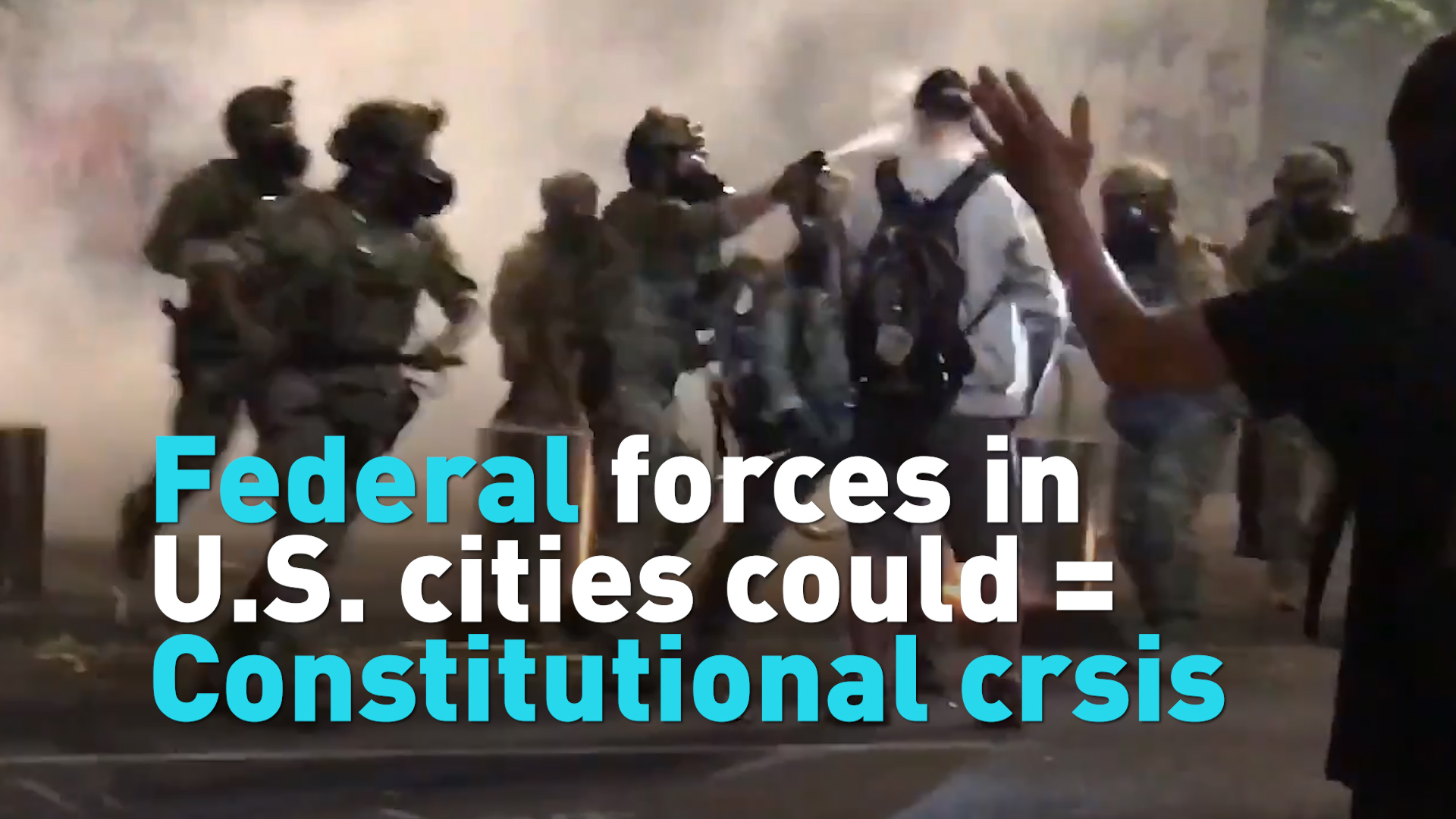
Protesters have been active in the U.S. city of Portland, Oregon, since the killing of George Floyd, an unarmed African-American man in Minneapolis police custody in late May.
It's just one of many cities where people are calling for police reform and consideration of Black lives.
But the situation in Portland changed earlier this month after federal agents were sent there under an Executive Order by President Donald Trump.
The officers were there to protect U.S. monuments, memorials, statues and property, and to combat "recent criminal violence," according to the Executive Order.
Trump's move allows forces to deploy without the permission of individual states.
For weeks, agents from the U.S. Marshal's Service, Federal Protective Service, U.S. Customs and Border Protection and Homeland Security have been a presence in Portland.
State and local officials say this has led to increased unrest, and those leaders have repeatedly asked authorities to leave their city.
On July 11, protester Donavan LaBella was shot in the head with a crowd control weapon reportedly fired by a federal officer.
He suffered a cracked skull and had to undergo facial reconstructive surgery.
A week later, federal police beat Navy veteran Christopher David with a baton and sprayed his face with tear gas.
David suffered two broken bones in his hand.
The Oregon Department of Justice filed a lawsuit against federal agencies for civil rights violations, and the office could pursue criminal charges against the officer who allegedly shot LaBella.
The state has also accused federal forces of arresting people without probable cause in the street, far from federal buildings and taking them away in unmarked cars.
"This is a democracy, not a dictatorship," Oregon Gov. Kate Brown, a Democrat, said on Twitter. "We cannot have secret police abducting people in unmarked vehicles. I can't believe I have to say that to the President of the United States."
On Tuesday, several citizens groups sued the federal government saying it violated the state's 10th Amendment which outlines federal powers delineated under the Constitution and state's rights.
Legal experts say that Trump's Executive Order could become a test case for state's rights and Trump's push to expand federal policing.
"It is a standard move of authoritarians to use the pretext of quelling violence to bring in force, thereby prompting a violent response and then bootstrapping the initial use of force in the first place," said Michael Dorf, a professor of constitutional law at Cornell University, in an interview with the AP.
Trump has shown no signs of backing down and has even pledged to send federal forces to other U.S. cities.
Earlier in June, the White House sent 200 federal agents to Kansas City to quell a surge in violent crime after the shooting death of a young boy.
On June 1, federal agents also used rubber bullets and tear gas to disperse crowds gathered outside the White House so Trump could get a photograph outside a church.
"We're going to have more federal law enforcement, that I can tell you," Trump said Monday. "In Portland, they've done a fantastic job."
He also tweeted: "The Radical Left Democrats, who totally control Biden, will destroy our Country as we know it. Unimaginably bad things would happen to America. Look at Portland, where the pols are just fine with 50 days of anarchy. We sent in help. Look at New York, Chicago, Philadelphia. NO!"
The Department of Homeland Security is planning to send 150 agents to Chicago, the AP reported, citing anonymous sources. They are expected to stay in Chicago for two months and make arrests for federal crimes, the AP said.
Chicago Mayor Lori Lightfoot said she's very concerned about the reports.
"I spent a lot of time yesterday talking with the mayor of Portland to get a sense of what's happened there," Lightfoot said. "We don't need federal agents without any insignia taking people off the streets and holding them, I think, unlawfully. That's not what we need."
Check out The China Report, our new weekly newsletter. Subscribe here!