- Home
- China
- World
- Asia-Pacific
- Americas
- Europe
- Middle-East and Africa
- Politics
- Business
- Opinions
- Tech & Sci
- Culture
- Sports
- Travel
- Nature
- Picture
- Video
- Live
- TV
- Specials
- Learn Chinese


Share






Copied
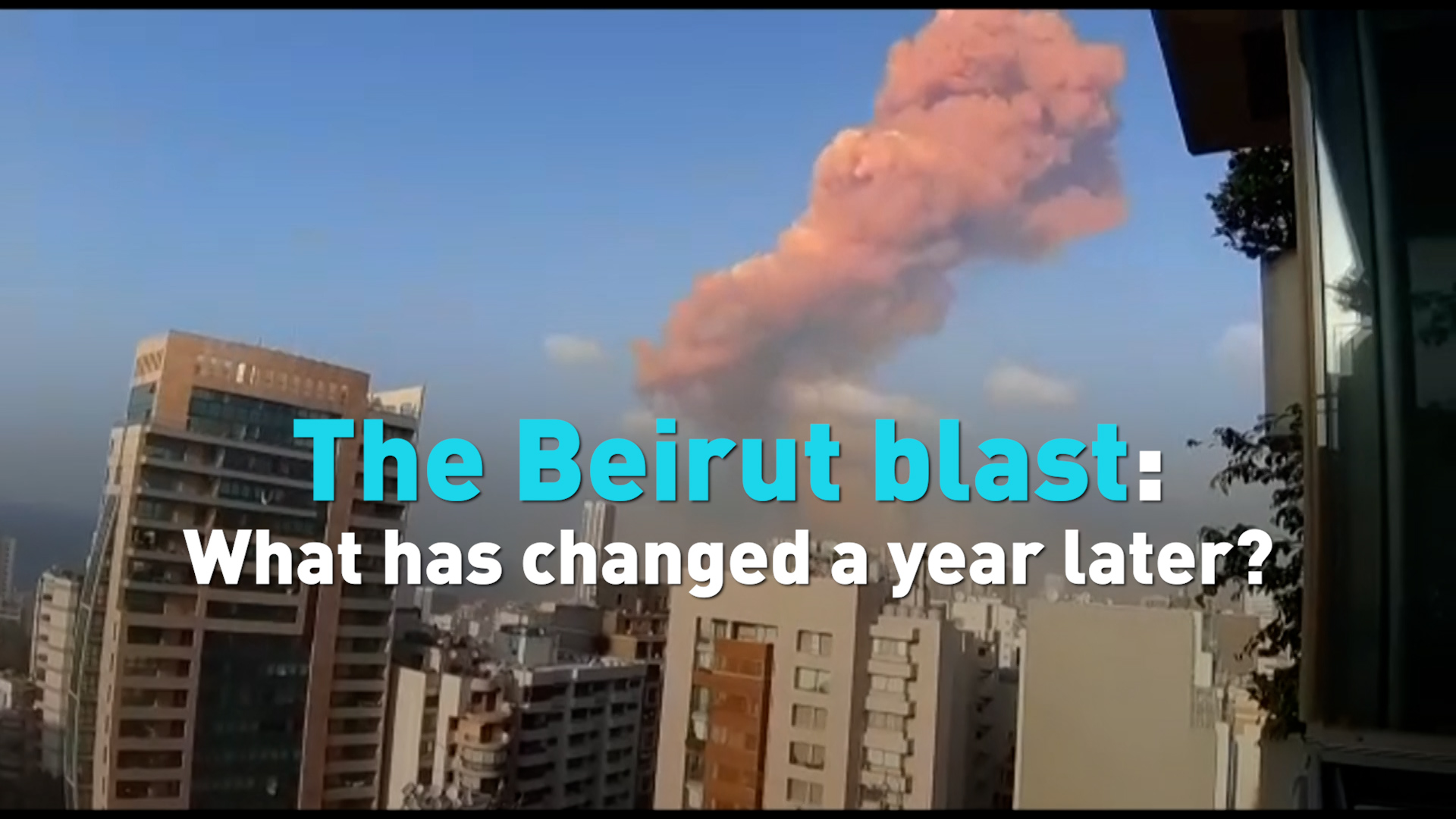
On the one-year anniversary of the Beirut explosion, thousands of Lebanese took to the streets, demanding accountability for the disaster.
The blast that rocked the Lebanese capital was one of biggest non-nuclear explosions in history. It killed 214 people and injured thousands. The shock wave flattened entire neighborhoods. People felt the tremors in Cyprus, 240 kilometers (150 miles) away.
At the port where the explosion occurred, survivors and relatives of victims carried flags and portraits of the dead.
Memorial services were marred by violence, as security forces fired water cannons and tear gas at protesters who had been throwing stones near parliament. The Red Cross said eight people were wounded in the clash.
A fire ignited ammonium nitrate, or fertilizer, stored at a dockside warehouse. More than 2,750 tons had been improperly stored at the port for years. Initial reports assumed all of it detonated, but Reuters reports seeing an FBI report that estimates around 20 percent, or about 550 tons, had exploded.
Frustrated by a lack of accountability, the Lebanese people have been calling for an investigation and prosecutions.
Sara Jaafar, an architect whose house was destroyed during the blast said: “This is too big of a crime for it to be swept under the carpet,” the Associated Press reports.
The political aftershocks have left Lebanon without a government for more than a year.
The World Bank described the country’s economic unraveling as one of the worst in 150 years.
UNICEF reports that a currency crash and hyperinflation have sunk over half the population below the poverty line, with 77 percent of households struggling to feed themselves.
Families seeking justice say investigations have been hampered by the country’s political elite.
On Wednesday, an international conference co-hosted by France and the United Nations raised over $357 million in humanitarian aid for Lebanon.
Check out The China Report, our new weekly newsletter. Subscribe here!
