- Home
- China
- World
- Asia-Pacific
- Americas
- Europe
- Middle-East and Africa
- Politics
- Business
- Opinions
- Tech & Sci
- Culture
- Sports
- Travel
- Nature
- Picture
- Video
- Live
- TV
- Specials
- Learn Chinese


Share







Copied
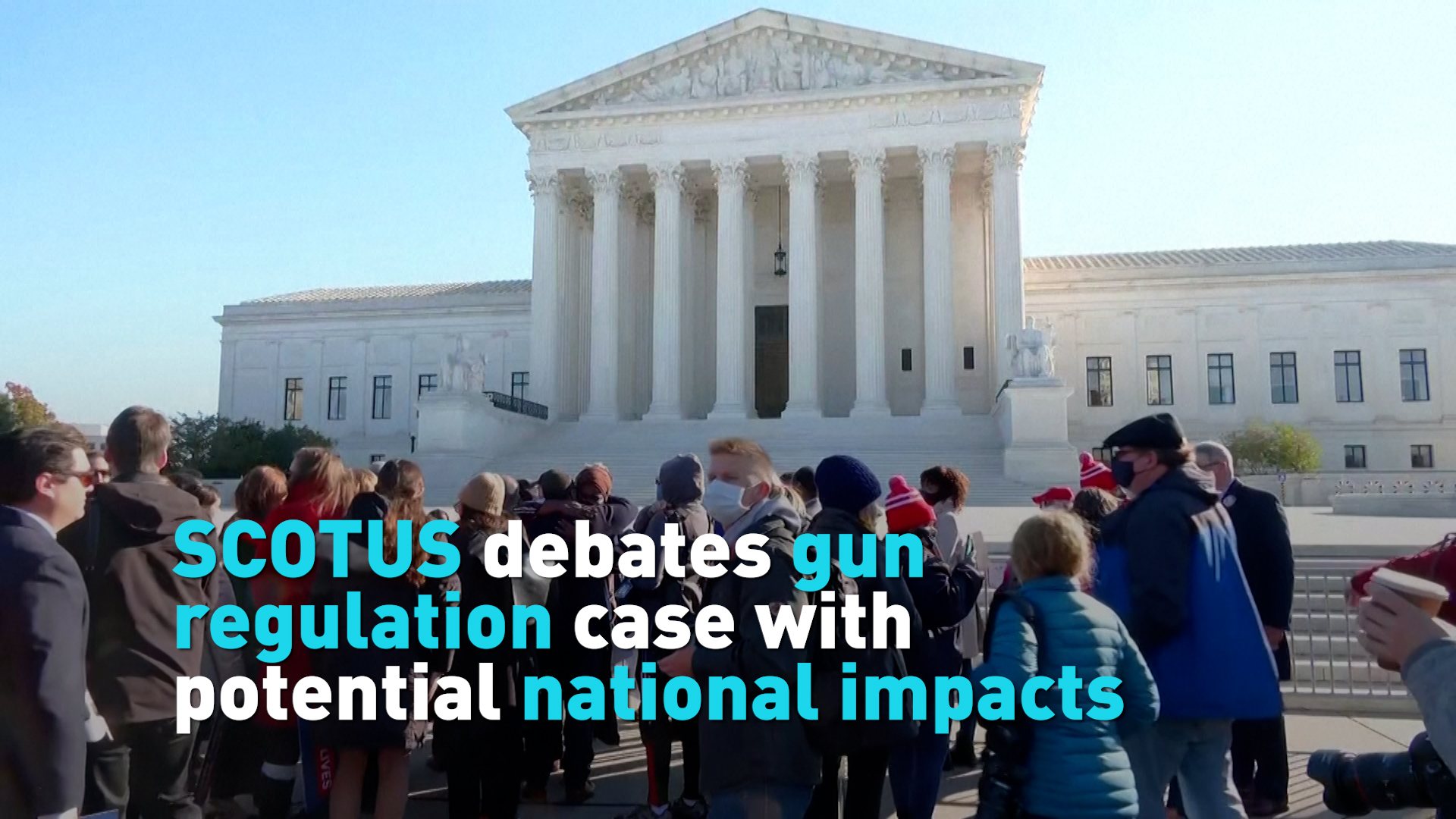
The U.S. Supreme Court is currently discussing a case that could stop states and local governments from banning loaded and concealed guns in public spaces.
In the state of New York, it is up to local police whether to issue a permit allowing someone to carry a concealed firearm in public. Permit applicants must show a special need for self-protection that's distinguishable from the general community.
The New York State Rifle and Pistol Association, an affiliate of the NRA, is challenging the law on behalf of two men who were denied permits to carry firearms publicly. One argued that he needed to carry gun in public spaces following a series of robberies in his neighborhood.
They argue that their Second Amendment rights were denied when law enforcement denied their permits.
The Supreme Court decision on this case, expected by the end of June 2022, will likely impact other states that have similar laws to New York, including California, Connecticut, Delaware, Hawaii, Maryland, Massachusetts, New Jersey and Rhode Island.
During the two hours of debate by the nine Supreme Court justices, questions raised indicate that the majority-conservative court seemed inclined to rule in favor of the rifle association.
Chief Justice John Roberts questioned why a constitutional right is in the hands of local officials. He also expressed concern that New York gave concealed carry permits more often in rural areas than urban ones where he felt there would be a greater need for self defense.
“How many muggings take place in the forest?” Roberts asked.
Justice Brett Kavanaugh also posed similar questions.
"Why isn't it good enough to say I live in a violent area and I want to be able to defend myself?" he said.
The state of New York argued that there while cities have different risks, they also have different public safety considerations.
Justice Samuel Alito said the law seems to give illegal-gun owners an advantage compared to "law-abiding citizens".
"All these people with illegal guns, they're on the subway, they're walking around the streets, but the ordinary hardworking law-abiding people... no they can't be armed," Alito said.
Justice Sonia Sotomayor, a liberal member of the court, cited the many examples throughout history including English law and Colonial American law that has regulated the carrying of weapons.
"I don't know how I get past all that history," she said.
The debate seemed to show the justices were willing to rule narrowly on the New York law, while still allowing the states to exclude guns from "sensitive places" such as universities, sports stadiums, and airports, the SCOTUS blog wrote.
The rifle association said during arguments that determining whether guns can be restricted at such places would need to be made on a case-by-case basis.
Outside the court, victims of gun violence rallied about the importance of regulations.
"We're here fighting for our right to not be shot," said David Hogg, a survivor of the 2018 Parkland, Florida shooting that left 17 students dead.
Also speaking was former Arizona Congresswoman Gabby Giffords who suffered brain injury after she was shot in the head while meeting with her constituents in 2011.
"Words once came easily, today I struggle to speak. But I [haven't] lost my voice," Giffords said. "We are at a crossroads: We can let the shootings continue or we can act."
Check out The China Report, our new weekly newsletter. Subscribe here!
