- Home
- China
- World
- Asia-Pacific
- Americas
- Europe
- Middle-East and Africa
- Politics
- Business
- Opinions
- Tech & Sci
- Culture
- Sports
- Travel
- Nature
- Picture
- Video
- Live
- TV
- Specials
- Learn Chinese


Share







Copied
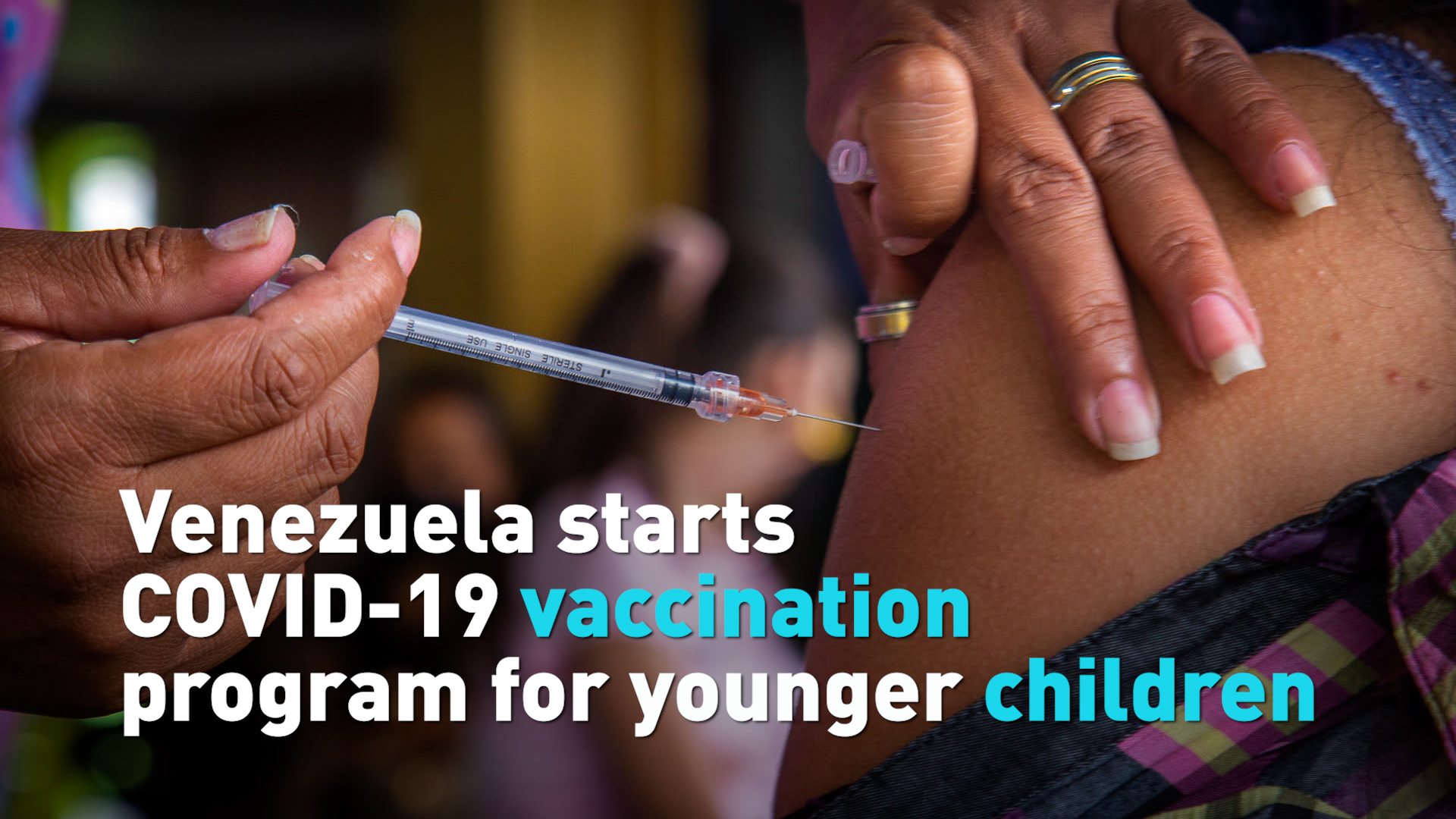
Venezuela is rolling out a COVID-19 vaccination program for children between the ages of 2 and 11. However, the decision to start giving doses to younger children is controversial.
There are questions about the safety of the vaccines approved by the Venezuelan government and the decision to allocate scant doses to children while some vulnerable citizens still haven't been inoculated.
Venezuela’s students and teachers returned to classrooms when the school year began in October 2021, following a year and a half of distance learning. But at some education centers, children attend in-person classes just twice a week.
As part of the push to fully reopen schools, Venezuela has started a COVID-19 vaccination campaign for kids.
Jhoana Hernández teaches at a primary school in Caracas and is excited to meet her students again. But as much as she would like to go back to classroom teaching full-time, Hernandez says getting kids vaccinated is a tough decision to make and she is still weighing her options.
“If they propose the Pfizer vaccine or the Chinese one for kids I would totally agree because those have been tested in other countries and have good results. However, with other vaccines, I won’t take that risk,” Hernández said.
The Venezuelan government says it has approved Cuba's Soberana 2 COVID-19 vaccine for children aged 2 to 11. And it says it had plans to approve another Cuban vaccine and a Chinese vaccine as well.

Venezuelan adolescents between 12-17 have been eligible for COVID-19 vaccination since October.

Venezuela is rolling out a COVID-19 vaccination program for children as young as two years old. The government says it has approved the Cuba's Soberana 2 COVID-19 vaccine for children.

The Pan American Health Organization reports that about 32 percent of Venezuela’s population is fully vaccinated.
But the Venezuelan Academy of Medicine has warned against the use of the Cuban vaccines, saying they have not been verified in independent clinical trials or approved by the World Health Organization.
“After seeing the clinical trials using China’s Sinopharm and Sinovac vaccines in South América, we consider them the best option to begin vaccination for kids two years and older,” said Dr. Enrique López Loyo, president of the Venezuelan Academy of Medicine.
Adolescents between 12- and 17-years-old have been eligible for COVID-19 vaccination since October. They’re getting China’s Sinopharm vaccine. Venezuela has also received doses of the Sputnik V vaccine from Russia.
For the three and a half million children in Venezuela between 2-11, parents will need to make a decision: to vaccinate or not to vaccinate.
For now, vaccinating children against COVID-19 is not mandatory, and it requires parental consent.
Amanda Mata is the legal guardian of her 8-year-old nephew Ismael. She says she is going to wait for more information on the Cuban vaccines, before taking Ismael to get a shot.
“There is no evidence to give me peace of mind, to know he will get something that’s going to help him. Otherwise, I feel he’ll be used as a guinea pig,” Mata said.
Pediatrician Lilia Vega says it is both a matter of trust and priorities. She is a member of a Venezuelan parents’ network that's urging the government to make vaccines for high-risk people a higher priority than vaccines for children.
“At some point, children and the whole population must be vaccinated. The thing is that in a country with limited resources for vaccination, extremely limited like we have in Venezuela, the priorities must be clearly defined," Vega said.
The Pan American Health Organization reports about 32 percent of Venezuela’s population is fully vaccinated.
Health experts say that as the virus continues to mutate, vaccinations will be more important than ever to protect both children and adults.
Check out The China Report, our new weekly newsletter. Subscribe here!
