- Home
- China
- World
- Asia-Pacific
- Americas
- Europe
- Middle-East and Africa
- Politics
- Business
- Opinions
- Tech & Sci
- Culture
- Sports
- Travel
- Nature
- Picture
- Video
- Live
- TV
- Radio
- Specials
- Learn Chinese


Share







Copied
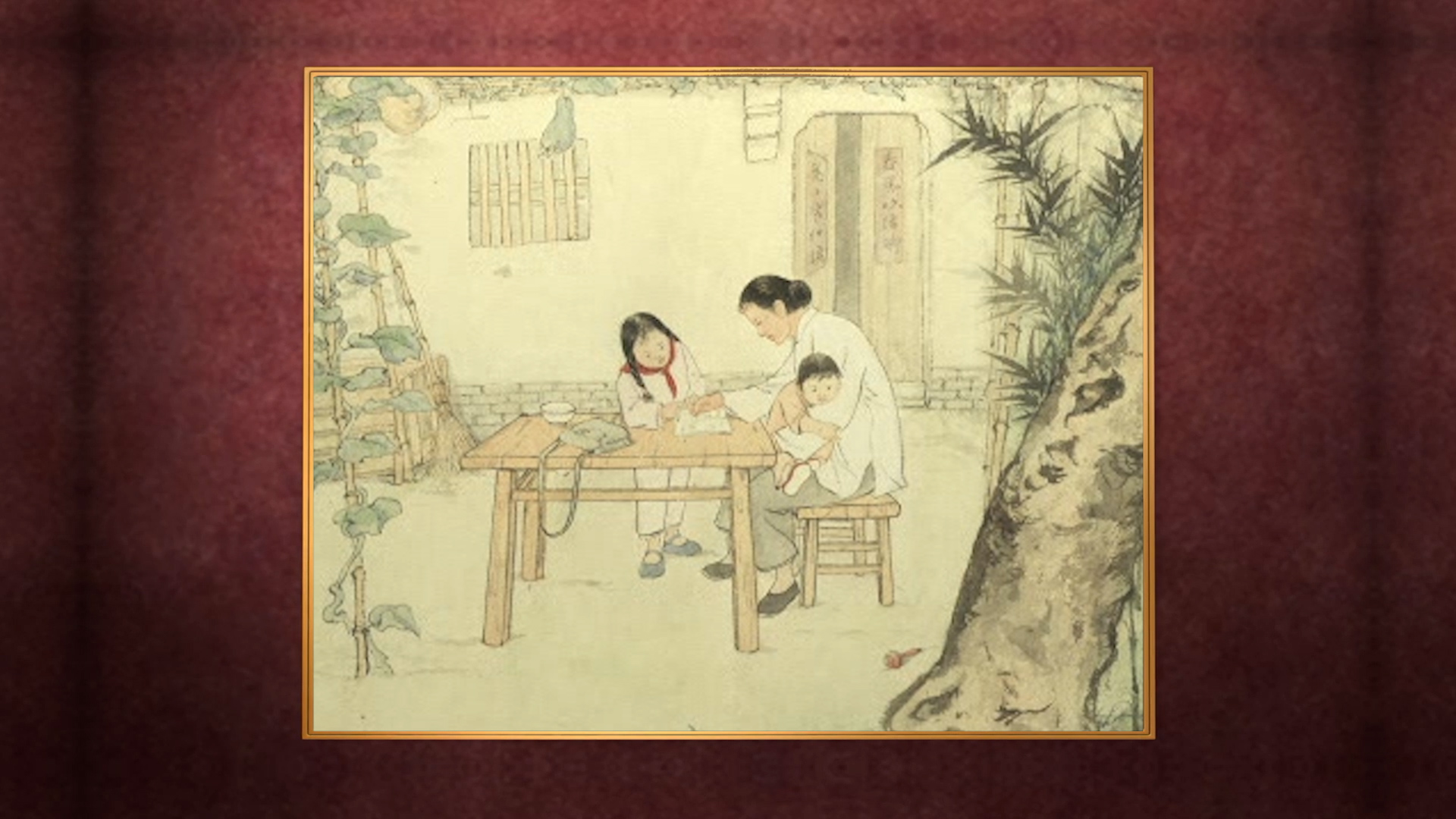
This Chinese traditional painting, entitled “Teaching Mom to Read,” was created by Chinese artist Lu Yanshao in 1956.
It promotes China’s national literacy campaign after the founding of the People’s Republic of China (PRC) in 1949.
China had been suffering from feudalism and wars for decades. Most ordinary people had no access to education.
At the founding of the PRC, 80 percent of its citizens were illiterate.
Lack of an educated population made it difficult for China to carry out plans for massive economic modernization.
During the National Conference on Industry, Agriculture and Education in 1950, a national literacy campaign was launched to reach workers and farmers.
To help people learn Chinese characters, Qi Jianhua, a teacher of the Southwest Military Region of the Chinese People’s Liberation Army created an “accelerated literacy method” in 1951.
The method teaches students to recognize Chinese characters using phonetic symbols.
In 1956, China’s State Council announced a national plan to eradicate illiteracy.
To help achieve its goal, China simplified Chinese characters and promoted Mandarin as the country’s standard language.
In February 1958, the National People's Congress, the country's top legislature, adopted the Chinese Pinyin spelling system, which is used as a crucial tool for readers to understand how to pronounce unfamiliar Chinese characters.
Between 1949 and 1964, about 100 million people in China were lifted from illiteracy.
The national literacy campaign built a solid foundation for China’s social and economic development.
Check out The China Report, our new weekly newsletter. Subscribe here!
