- Home
- China
- World
- Asia-Pacific
- Americas
- Europe
- Middle-East and Africa
- Politics
- Business
- Opinions
- Tech & Sci
- Culture
- Sports
- Travel
- Nature
- Picture
- Video
- Live
- TV
- Radio
- Specials
- Learn Chinese


Share







Copied
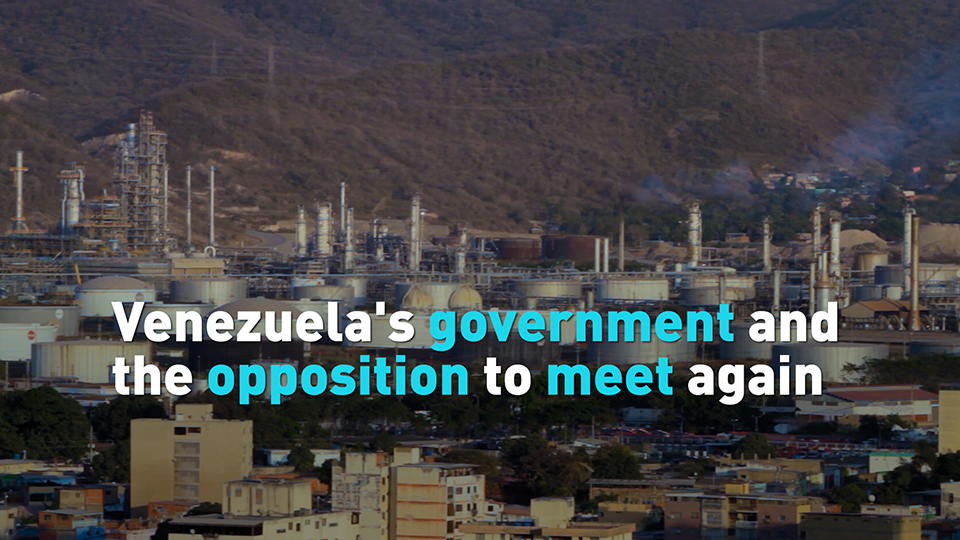
Venezuela's ongoing political crisis may be entering a new phase after the U.S. announced it is preparing to ease some energy sanctions on the oil-producing country. In return, Venezuela's government has said it will meet again with the opposition, to find a resolution to the long-term political crisis.
In August of last year, Venezuela's government and the opposition met in Mexico City to start negotiations. Less than a year later those talks remain on hold.
But a recent shift in U.S. policy towards Venezuela is changing not only the objectives but also the players taking part in deciding the country's future. Venezuelan negotiation expert Igor Cuotto, says the White House is playing a key role, offering incentives to promote dialogue.
"As the talks in Mexico were stuck, the government of the United States that is one of the main promoters of this process, because they have the sanctions, they say, to unlock this game I'm going to lift some sanctions for you to realize that in the extend we are advancing it can be more flexible" said Cuotto.
But the proposed change in U.S. policy may not be enough for Venezuelan President Nicolás Maduro who's demanding several changes in the ongoing process.
According to Phil Gunson a senior analyst for the Crisis Group, an independent non-profit organization with a presence in Venezuela, the Maduro government has not confirmed whether it wishes to continue with the process that so far has been mediated by Norway.
"We are seeing at the moment that there's not much willingness to return. What the U.S. is offering for Maduro to return to that negotiating table, does not satisfy him. Gunson also believes "Washington would have to go further for the government to really have reasons to return.”
So far, the U.S. is looking to ease some energy sanctions. It includes allowing Chevron, the last U.S. oil company working in the country, to discuss renewing its license with Venezuela's state oil company PVDSA, which is set to expire in June.
The potential lifting of some of the sanctions puts Venezuela's oil sector under the spotlight. Much of the local oil industry has fallen into disrepair and may not be able to quickly ramp up production.
Global attention is now centered on oil due to the conflict taking place in Ukraine. Chevron says they are ready to boost Venezuela's oil output if sanctions are lifted. But for experts like Energy Legal Consultant César Mata it is a long-term bet.
"Production will not increase the next day, it requires investment, drilling, oil rigs, to comply with commitments, payments, guarantees and legal security." Mata says it will take time but it could send a positive signal to the markets. "So it is something that won't be seen immediately, but rather the beginning of a change that will impact the Venezuelan oil production.”
For now, the government and the opposition have committed to return to talks. But no date or location have been set. Delegates from the two sides appeared in a photograph on Twitter, saying they are working on a future plan to resume talks.
Phil Gunson who has been following Venezuela's political crisis since 1999 and has kept a close look at the dialogues between the government and the opposition, explains the challenges to returning to the negotiation table.
"Every time that a negotiation process collapses it is harder to reset it, and it gets more complex. The idea is that this opportunity is used to get some sort of agreement.”
Mexico has said it is ready to welcome the delegations once again. And topping the opposition's agenda will likely be ensuring a free and fair presidential election in 2024.
For more, check out our exclusive content on CGTN Now and subscribe to our weekly newsletter, The China Report.
